








Get sales advice from our team 7 days a week
0871 244 0934Most businesses spend time thinking about how to buy technology, but far fewer think about what happens after it has been rolled out. That is often where the real inefficiencies begin.
Devices are kept a little longer than planned. Performance starts to dip. Teams work around slower machines because they are still technically usable. Then, before long, the business is facing a bigger and more urgent replacement decision than it expected.
Leasing can help with the upfront cost of business technology, but long-term value comes from more than the initial transaction. It comes from managing your device estate properly over time — knowing when to upgrade, where trade-in fits, and how to avoid leaving useful value tied up in ageing tech.
Buying tech is one decision. Managing it well is another.
It is easy to treat a device purchase as a finished task. The laptops arrive, the team is set up, and attention moves elsewhere.
But business technology rarely stays static for long. Teams grow, roles change, software becomes more demanding, and the way people work shifts over time. What felt like the right solution at the point of purchase may not be the right fit 18 months or two years later.
That does not mean the original buying decision was wrong. It usually means the business has moved on.
The issue is that many organisations only review their setup once something starts going wrong. At that point, the refresh becomes reactive. Devices are no longer supporting the business as well as they should, and the next decision is driven by urgency rather than planning.
A better approach is to think of technology as an ongoing business asset, not a one-off purchase. That creates more room to plan ahead, make better use of budget, and take a more controlled approach to upgrades.

There is a common assumption that the longer a business keeps a device, the more value it gets from it. Sometimes that is true. But not always.
A laptop that has already been paid for can look like the cheapest option on paper. In practice, though, an ageing device may be costing more than it seems. It may be slower to use, less reliable, harder to support, or no longer suited to the demands of the role. Those issues do not always show up clearly on a budget line, but they still affect productivity and day-to-day efficiency.
This is where businesses often lose value without realising it. They are not overspending on the purchase itself. They are losing value in the years that follow.
Holding onto devices for longer is not always the same as getting better value from them. Sometimes it simply delays spend while performance, consistency and user experience gradually fall away.
That is why timing matters. The best point to review your estate is often before devices become a visible problem, not after.
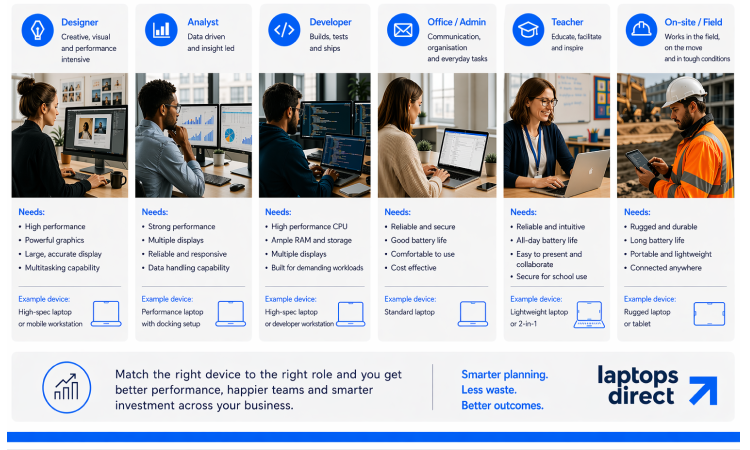
One of the simplest ways to improve business tech planning is to stop treating every role the same.
A designer, analyst, developer or power user will place very different demands on a machine compared with someone working mainly on email, admin or general office tasks. Yet many businesses still buy and refresh as if every employee needs the same device, on the same cycle, for the same reasons.
That can create waste in both directions. Some users end up with more performance than they need, while others are left trying to do demanding work on devices that are no longer fit for purpose.
That does not make your setup more complicated. In many cases, it makes it more efficient.
The goal is not to refresh everything at once just because one part of the estate needs attention. The goal is to make sure investment reflects how the business actually operates.
When businesses replace devices, the outgoing tech often gets very little thought.
It gets stored away, passed around internally, left in cupboards, or simply written off as old kit. But that overlooks an important point: older devices can still hold value.
Trade-in gives businesses a way to recover some of that value and put it towards what comes next. Rather than allowing old devices to sit idle, it helps turn them into part of the budget for a refresh.
This is one of the reasons planning ahead matters so much. If you review devices while they still hold useful residual value, you have more options. Leave it too late, and that value often drops alongside performance.
Trade-in will not remove the cost of upgrading entirely, but it can improve the overall economics of the decision. It also encourages a better mindset. Instead of focusing only on what needs buying next, businesses can also think about what they already have, what it may still be worth, and how that value can be used more effectively.
Visit our sell your old tech page to find out more and sell your old laptop, phone or tablet with us.

Once a business realises its current setup needs attention, it can be tempting to think in extremes: either keep everything as it is, or replace the whole estate.
In reality, the best answer often sits somewhere in the middle.
For some businesses, a full refresh will make sense. That may be because the estate is heavily outdated, inconsistent across teams, or no longer aligned with how the business works. But in many cases, a phased or blended approach is the smarter option.
You might refresh the highest-demand users first, where performance has the biggest operational impact. You might prioritise devices in specialist or customer-facing roles, while lower-demand teams continue on a longer cycle. You might also choose a mix of new and refurbished options depending on role, budget and expected lifespan.
The important point is that an upgrade strategy does not need to be all or nothing.
A well-managed refresh should reflect need, not habit. It should be based on how people work, where the pressure points are, and where investment is likely to have the greatest effect.

Leasing is often viewed purely as a funding solution, and that is a big part of its appeal. It can help businesses avoid large upfront costs and make spending more predictable.
But its value is even stronger when it sits within a wider technology strategy.
If a business understands its likely refresh cycles, knows which roles need what level of performance, and uses trade-in where appropriate, leasing becomes more than just a way to pay. It becomes part of a more flexible and controlled way to manage technology over time.
That is where the commercial benefit starts to build.
Instead of waiting for a major replacement moment and solving everything at once, businesses can plan ahead with more confidence. They can think in stages, align spend more closely to need, and avoid tying every upgrade decision to a single large capital outlay.
Leasing supports the upfront decision. Lifecycle planning improves everything that follows.
Find out why more businesses are choosing leasing over upfront spend and why it is the most practical option.

At its core, this is not just about reducing cost. It is about improving control.
When businesses think more carefully about upgrades, trade-in and lifecycle planning, they are usually trying to solve a wider set of challenges. They want more predictable spend. They want technology that supports productivity properly. They want fewer reactive decisions. And they want to avoid wasting value in equipment that no longer fits the role but still has something left to give.
That is why this conversation matters.
Technology should not become a background problem that only gets attention when performance drops too far or budgets get squeezed too tightly. Managed well, it becomes what it should have been all along: a business asset that continues to support growth, efficiency and change over time.
The better question is not just what should we buy next. It is how long should this setup serve us, when should we review it, and how do we make the next decision more efficiently than the last one?




