








Get sales advice from our team 7 days a week
0871 244 0934Headsets have promised the workplace a lot before and rarely paid it back. The Galaxy XR, however, is a very different proposition.
It is an AI-native device built on an open platform that seamlessly runs the Android apps your team already relies on. If you're wondering how this fits into your day-to-day operations, here is a straightforward look at where it earns a solid business case, and where it doesn't quite yet.
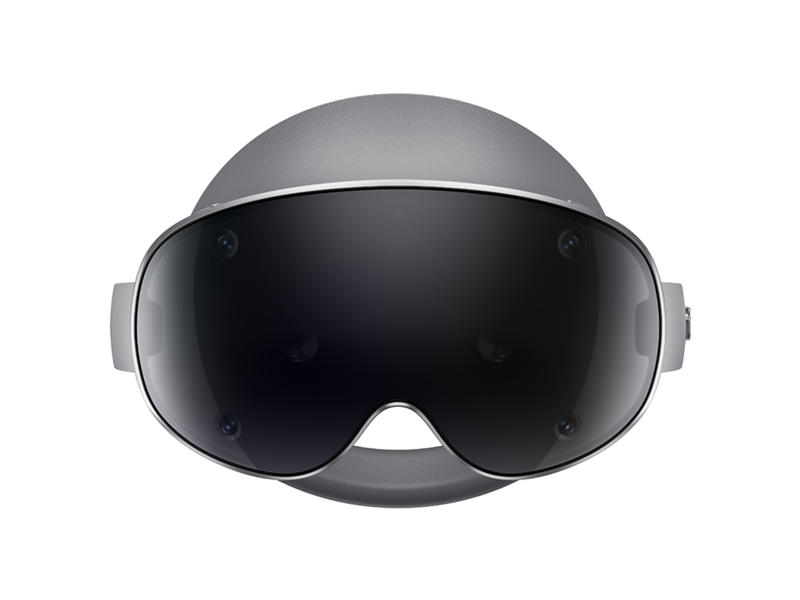
What the Galaxy XR actually is
Galaxy XR is the first product to utilise Android XR, a platform Samsung has co-developed with Google and Qualcomm. Gemini AI is integrated right at the system level rather than being bolted on as an afterthought. This means the headset naturally understands what the wearer is looking at and effortlessly responds to voice, vision, and gesture together.
The internal hardware is seriously impressive, featuring a Snapdragon XR2+ Gen 2 processor paired with 16GB of memory. It also boasts dual Micro-OLED displays totalling a massive 27 million pixels, giving you a 109-degree horizontal field of view. The headset weighs just 545g including its forehead cushion, and uses a separate 302g battery pack that sits comfortably off your head.
The real commercial advantage is simple: it runs Android. Apps built for the Android platform work straight out of the box, and developers can bring existing projects across using OpenXR, WebXR, or Unity. You won't need to commission a bespoke build just to get a pilot project off the ground.
Shop now »The short version is this: the Galaxy XR is worth the investment when the task you are simulating is expensive, dangerous, or difficult to rehearse in real life. Here are the primary ways businesses are using it right now:
Samsung has successfully partnered with Samsung Heavy Industries to use the Galaxy XR for virtual shipbuilding training, specifically aimed at improving work productivity and safety. This applies perfectly to any procedure that is costly to rehearse for real. You can run the failure case as many times as necessary without ever booking plant time or putting a trainee near live equipment. It also ensures complete consistency, as every site receives the exact same training session.
Looking at a 3D model on a monitor is just looking at a picture. In XR, the model is the exact size it will actually be, allowing you to physically walk around it. The headset tracks your head, hand, and eye movements precisely enough that the interaction feels physical rather than mouse-driven. If your current cycle spends money on physical prototypes or catches clashes late in the game, this is exactly where the savings sit.
Six microphones featuring beamforming technology filter out room noise and capture the wearer's voice crystal clearly. A highly useful Pass-through mode keeps the physical workspace visible, meaning a technician can join a shared session while still seeing their hands and the control panel in front of them. Circle to Search even works in pass-through; simply draw a circle with your hand around an unfamiliar part in the room to search it instantly.
The brilliant 4K Micro-OLED panels are marketed as a personal theatre, providing you with as many large virtual screens as you want, anywhere you are. For analysts, traders, or anyone hot-desking across various sites, this completely removes the need for physical monitors. Because it can be used while charging, a fixed desk setup is incredibly viable.
| Sector | Primary Use Cases |
|---|---|
| Healthcare | Used for medical training, remote patient care enhancement, and simulating complex surgical or clinical environments. |
| Manufacturing & Engineering | Employed by independent software vendors and engineers for 3D product design, spatial prototyping, and guided factory assembly. |
| Retail & E-Commerce | Utilised to build immersive shopping experiences, allowing consumers to virtually try on clothing or visualize how furniture looks in a physical room. |
| Corporate Training & Collaboration | Deployed by IT administrators for multi-user virtual meetings, employee onboarding, and safety training through managed application distribution. |
| Professional Services | Used by office workers for next-level multitasking, utilizing unlimited virtual monitors and shared digital workspaces. |
There are four practical things that catch most businesses out on their first deployment:
Nobody signs off a hundred headsets based purely on a hunch. Start narrow, measure your results honestly, and let the numbers decide the wider rollout.
1. Pick one process
Select one specific procedure that has a cost you already measure.
2. Size the kit
Organise your headsets, spare batteries, optical inserts, charging solutions, and always include one spare unit for the group.
3. Run both ways
Run your old method and the XR method side by side for a full cycle. Compare the same four numbers (time to competence, error rate, trainer hours, and travel spend).
4. Scale by site
Opt for staged delivery, complete with asset tagging and stock held ready for the phases that follow.
If your organisation trains people on something that is expensive, dangerous, or hard to access, the answer is a resounding yes. The business case easily closes on the training cost alone, making everything else an added upside.
However, if you are hoping to completely replace laptops with headsets across the board, the answer is not yet. With battery life offering up to 2.5 hours of video playback, current wear time dictates that this is a session device rather than an all-day replacement.
What makes the Galaxy XR brilliant to adopt right now is the platform sitting underneath it. Android XR is heavily built to scale across future form factors (including AI glasses) and proudly runs on OpenXR standards. Whatever software you build for a headset today will still be incredibly valuable on whatever hardware comes next.




