








Get sales advice from our team 7 days a week
0871 244 0934For years, buying business technology outright was seen as the standard approach. A business needed new laptops, desktops, monitors or tablets, so it approved the budget, made the purchase, and expected the devices to last for as long as possible.
That approach still works for some organisations. But for many, it is no longer the most practical option.

Technology now plays too central a role in productivity, security, customer service and day-to-day operations to be treated as a one-off purchase that is then stretched beyond its ideal life. Businesses are under pressure to stay current, support hybrid working, manage cashflow carefully, and keep teams equipped without creating big spikes in spend. That is why more are choosing leasing over upfront purchase.
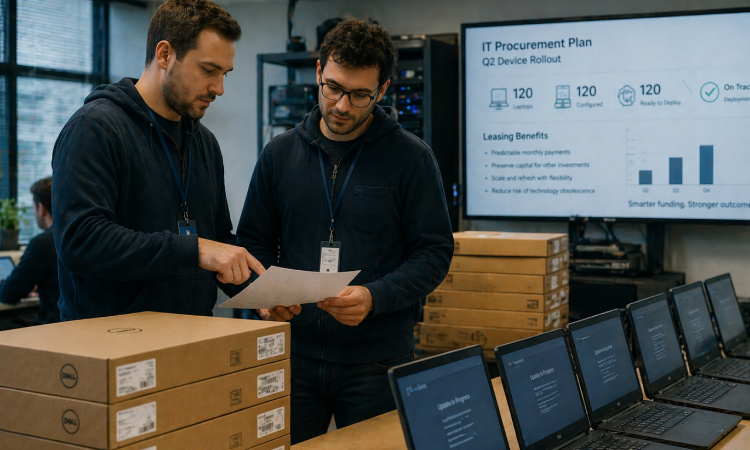
Instead of tying up capital in a large technology order, leasing gives businesses a way to spread cost into predictable payments, plan refreshes more clearly, and build flexibility into the way they fund devices. It is a shift in mindset as much as a funding model. The question is no longer just, “Can we afford to buy this now?” It is increasingly, “What is the smartest way to equip the business without creating unnecessary pressure?”.
A full device refresh can be expensive, especially when it involves more than just laptops. Businesses often need accessories, monitors, docking stations, tablets, and sometimes eligible software wrapped into the same project. Even if the organisation has the budget, that does not always mean it wants to commit a large amount of cash in one go.
Cash tied up in technology is cash that cannot be used elsewhere. For a growing business, that could mean less flexibility for hiring, operations, stock, premises or wider investment. For an established one, it can still create unnecessary pressure on budgets and approvals.
Rather than one large upfront payment, the cost is spread over an agreed term, with payment schedules that can work around how the business manages its finances. That makes budgeting easier and helps remove the shock of large one-off procurement costs.
Few businesses stay still for long. Teams grow. Sites open. Projects change. Requirements shift. A device estate that works today may need adjusting in 12 or 24 months.
That is one of the biggest reasons leasing is gaining ground. It is often a better fit for how organisations actually work in the real world. Instead of buying everything upfront and hoping it remains the right setup for years, leasing gives businesses a more flexible framework to work within.
This matters across a wide range of sectors:
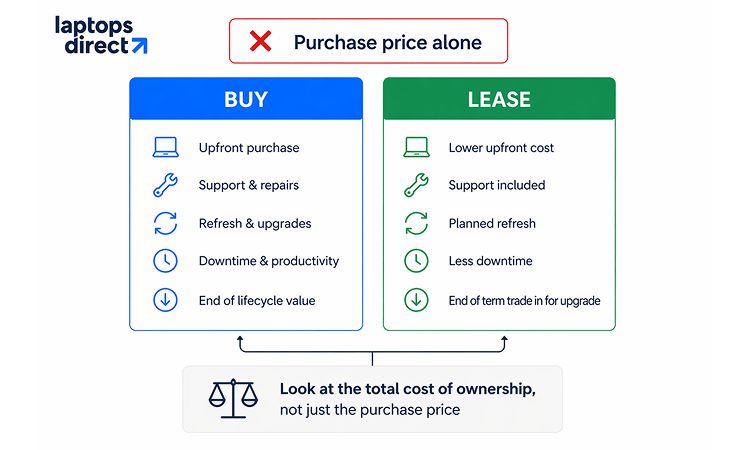
One of the most common mistakes is to compare leasing and buying on purchase price alone. Yes, outright purchase may sometimes look cheaper at first glance. But businesses rarely experience technology costs in such a simple way. The real picture also includes refresh timing, device consistency, support, downtime, ageing hardware, internal resource, and what happens at the end of the lifecycle.

If devices are held for too long, businesses can face a different kind of cost: slower performance, compatibility issues, increased failures, frustrated teams, and a rushed refresh when things finally become too outdated to ignore.
Leasing helps avoid that pattern by giving businesses a clearer structure around refresh planning and end-of-term options. Rather than reacting late, they can plan ahead.
Predictability is one of the strongest arguments for leasing.
Instead of budgeting for irregular spikes in spend every few years, businesses can move to a more structured payment model. That makes forecasting easier and can reduce the friction around internal approvals.
It also gives decision-makers more confidence. They know what they are committing to, what the term looks like, and what routes may be available at the end.
For many organisations, that is more valuable than the idea of owning every device outright.
Many businesses hold onto devices too long. That is understandable. If the hardware still turns on and the business owns it, it can feel sensible to keep using it.
But older estates can bring hidden issues. Devices may be slower, less secure, less compatible with newer software, or more likely to create support headaches. Standardisation can slip too, especially if replacements are bought ad hoc over time.
Leasing can support a more proactive refresh cycle. Because the agreement already has a defined term, there is a natural point for the business to review what comes next. That encourages better planning rather than last-minute replacement.
It also helps businesses stay closer to a “fit for purpose” estate rather than one that is simply being kept alive.
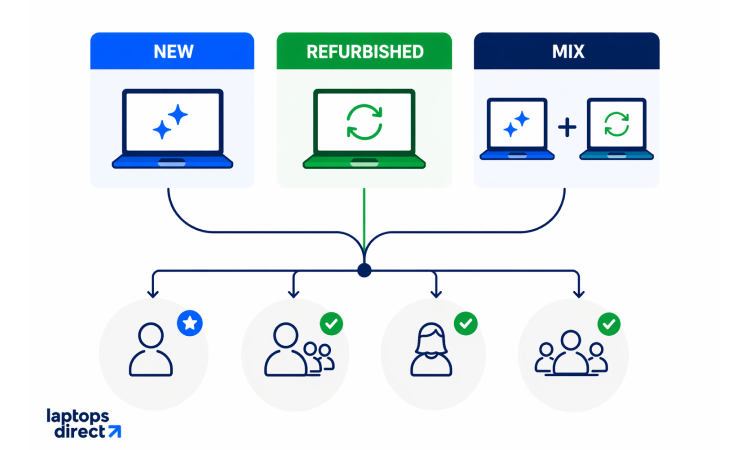
Another reason leasing has become more attractive is that it no longer has to mean one rigid device model across every role.
Businesses often have a mix of requirements. Some users need high-performance new devices. Others can be well served by refurbished options. Some businesses benefit most from a blended approach that balances performance, budget and sustainability.
That flexibility matters.
A senior leadership team, developer or specialist role may justify new, higher-spec hardware. An admin team, backup pool, seasonal workforce or wider rollout may be better suited to refurbished devices where appropriate. Leasing can support that kind of role-based thinking far better than a single all-or-nothing purchasing decision.
Find out more on how to choose the right leasing setup for your budget.
Businesses are already comfortable with subscription models in many parts of their operations. Software, platforms, tools and services are increasingly paid for over time rather than bought outright. Technology hardware is starting to sit within that same mindset.
That does not mean ownership has no value. It means many businesses now care more about access, usability, lifecycle planning and operational fit than the simple fact of owning an asset.
In that context, leasing feels less like an alternative and more like a natural extension of how modern procurement works.
Some decision-makers still hesitate because they assume leasing is more complicated than buying. In practice, it can often make planning simpler.
Others worry that leasing means giving up control. In reality, it can give businesses more structure around how they fund and refresh technology, especially when there are clear end-of-term routes and a straightforward quote-led process.
There is also the assumption that it is only relevant for large organisations. That is not the case. Leasing can work for smaller teams, growing businesses, multi-site operations and larger rollouts alike.
Because outright purchase is not always the most efficient use of cash.
Because technology needs to stay current.
Because businesses want predictable costs instead of irregular budget shocks.
Because refresh planning matters more than ever.
Because many organisations now value flexibility just as much as ownership.
The smartest procurement decisions are not always about buying the cheapest way possible today. They are about building a model that supports the business properly over time.




